SỞ GIÁO DỤC - ĐÀO TẠO KỲ THI HỌC SINH GIỎI CẤP THÀNH PHỐ LỚP 9 – THCS
TP HỒ CHÍ MINH KHÓA NGÀY: 19/03/2014 – NĂM HỌC: 2013-2014
ĐỀ CHÍNH THỨC
Đề này gồm 4 trang
PART ONE. LISTENING (25 pts)
Recording One: Listen to the recording carefully, then write down the missing word(s) in each blank in your Answer Sheet.
The Hindenburg was the last in a series of ______ which had been developed over 40 years in both Europe and
the United States. They were designed to carry passengers and in (2)______ over long distances. The Hindenburg could
carry 50 passengers (3)______ in 25 luxury cabins with all the amenities of a first class hotel. All the cabins had hot and
cold water and electric (5)______. There was a dining-room, a bar and a (4)______ with a dance floor and a baby grand
piano. The Hindenburg had been built to compete with the great luxury trans-Atlantic liners. It was (6)______ metres
long with a diameter of 41 metres. It could (7)______ at a speed of 125 km/h and was able to cross the (8)______ in
less than half the time of a liner. By 1937 it had carried 1000 passengers safely and had even (9)______ circus animals
and and cars. Its sister ship, the Graf Zeppenlin, had (10)______ one and a half million kilometres and it had carried
13,100 passengers without incident.
Recording Two: Listen to the recording carefully, then decide whether each of the statements is True or False. Write TRUE or
FALSE in your Answer Sheet.
11. The lady interviewed is a physicist.
12. In the future, people will food as medicine.
13. A.I. stands for Artificial Intelligence.
14. Robots in the future are logical but not emotional.
15. Robots will be like people, so they won’t be able to work in any kinds of weather.
Recording Three: Listen to the recording carefully, then write short answer to each question about the recording.
16. Where should the device go on the user’s body?
17. What, besides touching the screen, can the user do to operate the device?
18. What should people use to listen to the music better?
19. How can people operate the new revolutionary computer?
20. Why is the screen bigger?
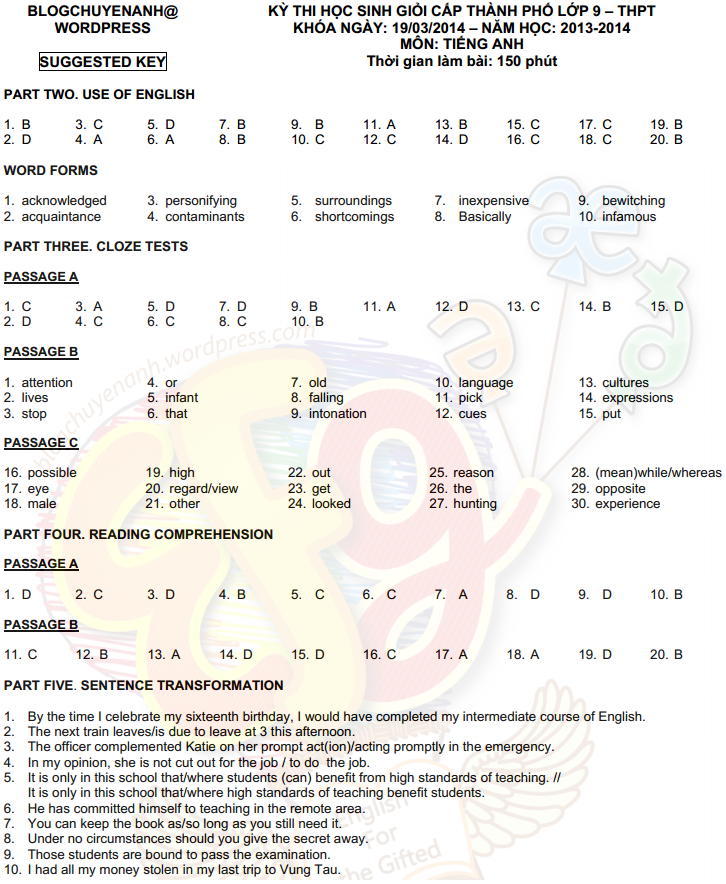
PART TWO. USE OF ENGLISH
A. Choose the word or phrase (A, B, C or D) that best completes the sentence. (20 pts)
1. Learning in this center, you can benefit a lot from our updated teaching ______.
A. solution B. method C. treatment D. mode
2. I’d rather that they ______ so many mistakes in the last test.
A. didn’t make B. couldn’t make C. weren’t be making D. hadn’t made
3. They’ve suggested many solutions, ______ are feasible, in my opinion.
A. neither of which B. none of them C. none of which D. not any of them
4. We ______ had they asked us to.
A. could have helped B. would help C. must have helped D. needn’t have helped
5. An ______ can tell people their future by reading their constellation.
A. archeologist B. astronaut C. astronomer D. astrologer
6. The hotel was really filthy, and I’m not ______.
A. exaggerating B. lying C. amplifying D. boasting
7. I’m not accustomed ______ in public.
A. to speaking B. to speaking C. speaking D. with speaking
8. He gave her ______ ring in the wedding ceremony.
A. such big beautiful diamond B. a beautiful big diamond
C. so beautiful a diamond big D. a big diamond beautiful
9. His evidence doesn’t ______.
A. fall for B. add up C. figure out D. set in
10. I’m worn out. I could ______ a cup of tea.
A. put up with B. call for C. do with D. come in for
11. I was caught parking on a double yellow line and had to pay a parking ______.
A. fine B. charge C. fee D. cost
12. What was your reaction ______ what he said?
A. of B. with C. to D. on
13. I’m not surprised he became an author. Even as a child he had a ______ imagination.
A. large B. fertile C. bright D. clean
14. Lucie is honest; and I mean “honest” in the broadest ______ of the word.
A. meaning B. value C. idea D. sense
15. Angela’s work was praised for its ______ attention to detail.
A. meticulous B. significant C. subtle D. concentrated
16. The more expensive carpet is a good choice ______ it will last longer.
A. so that B. owing to C. in that D. but for the fact that
17. _ “Can I use your phone? “______”
A. I’m afraid so. B. Might as well! C. Be my guest! D. Serves you right.
MÔN: TIẾNG ANH
Thời gian làm bài: 150 phút
18. _ “What do you think of the film we’ve watched? _ “______”
A. It’s a breeze! B. Absolutely! C. I’ve seen better! D. None of your business!
19. He leads a quite difficult life; he can just ______.
A. run errands B. make ends meet C. make allowance for it D. mind his own business
20. He won the match ______.
A. from hands to mouth B. hands down C. near at hand D. hands up
B. Word Forms
Use the correct form of the word given to fill in each blank. (20 pts)
1. Wimbledon is widely ______ as being the premier tennis tournament. (know)
2. Frankly, they are just my mere ______. (acquaint)
3. I really appreciate the author’s ______ the animals in that fable. (person)
4. The water in this lake is poisoned by ______. (contaminate)
5. Our new ______ are a lot more beautiful than we expected. (surround)
6. You should choose a partner who compensates for your personal ______. (short)
7. Judo is an ______ sport to take up because you do not need much equipment. (expense)
8. ______ speaking, their goal is to promote healthier eating habits. (basis)
9. The audience was completely absorbed in their ______ performance. (witch)
10.He was known as a(n) ______ criminal. (fame)
PART THREE. CLOZE TESTS
Read the passage and choose the best option (A, B, C or D) for each blank space.
PASSAGE A (15 pts)
When you buy something from a shop, you are making a contract. This contract means that it’s up to the shop – not the
manufacturer – to (1)______ your complaints if the goods are not satisfactory. If the shop sells you faulty goods, it has
(2)______ its side of the contract. If goods are faulty when you first (3)______ or use them, go back to the shop, say that
you cancel the (4)______ and ask for a complete refund. If you prefer, you can accept a repair or a (5)______.
If the goods break down through no (6)______ of yours, after you have used them for a time, you may still be
(7)______ to some compensation. In some cases it would be reasonable to expect a complete refund – if, for (8)______,
without misuse your shoes (9)______ after only one day’s wear, or your washing machine (10)______ broke down after
only three wash days. But if your washing machine worked perfectly for a while and then broke you could only expect some
of the purchase price back. You and the supplier must (11)______ a reasonable settlement.
You need never accept a (12)______ for faulty goods. If you do so, then later find you do not want anything in the
shop or store, you may not get you money back.
If you have to spend money as a (13)______ result of goods being faulty, you can also (14)______ this from the shop.
You could, for example, claim the cost of using a laundry while the washing machine wasn’t working. But you must keep
such (15)______ down to a minimum.
1. A. do away B. carry out C. deal with D. make up
2. A. done B. conformed C. taken D. broken
3. A. inspect B. touch C. investigate D. inquire
4. A. program B. project C. purchase D. sale
5. A. substitution B. transform C. modification D. replacement
6. A. defect B. flaw C. fault D. error
7. A. adjusted B. devoted C. allergic D. entitled
8. A. good B. the time being C. instance D. for all time
9. A. broke up B. came apart C. worn away D. fell through
10. A. illegally B. irreparably C. irreversibly D. unreasonably
11. A. negotiate B. talk C. quarrel D. conclude
12. A. paper sheet B. leaflet C. money bill D. credit note
13. A. perfect B. straight C. direct D. full
14. A. force B. claim C. take D. obtain
15. A. earnings B. mortgages C. savings D. expenses
Fill in each of the blanks in the following passage with ONE suitable word.
PASSAGE B (30 pts)
Long before they can actually speak, babies pay special (1)______ to the speech they hear around them. Within
the first month of their (2)______, babies' responses to the sound of the human voice will be different from their responses
to other sorts of auditory stimuli. They will (3)______ crying when they hear a person talking, but not if they hear a bell
(4)______ the sound of a rattle. At first, the sounds that an (5)______ notices might be only those words that receive the
heaviest emphasis and (6)______ often occur at the ends of utterances. By the time they are six or seven weeks
(7)______, babies can detect the difference between syllables pronounced with rising and (8)______ inflections. Very
soon, these differences in adult stress and (9)______ can influence babies' emotional states and behavior. Long before
they develop actual (10)______ comprehension, babies can sense when an adult is playful or angry, attempting to initiate
or terminate new behavior, and so on, merely on the basis of cues such as the rate, volume, and melody of adult speech.
Adults make it as easy as they can for babies to (11)______ up a language by exaggerating such (12)______. One
researcher observed babies and their mothers in six diverse (13)______ and found that, in all six languages, the mothers
used simplified syntax, short utterances and nonsense sounds, and transformed certain sounds into baby talk. Other
investigators have noted that when mothers talk to babies who are only a few months old, they exaggerate the pitch,
loudness, and intensity of their words. They also exaggerate their facial (14)______, hold vowels longer, and (15)______
emphasis on certain words.
PASSAGE C (30 pts)
Did you know that if you want your pet cat to live as long as (16)_____ you should choose an ordinary female cat,
keep a close (17)______ on her in spring and summer, and make sure that she is not black or black and white? It has
been discovered that (18)______ cats wander further from home, and of the large number of cats killed on the roads in
spring and summer, a surprisingly (19)______ percentage are black or black and white. Did you know, too, that domestic
cats (20)______ their owners as fellow members of the cat family and make many more sounds to us than they do to
(21)______ cats when living in groups? They have worked (22)______ that we communicate by sound and so learn a
vocabulary we will understand to (23)______ their message over.
The way cats have learned to live with, and be (24)______ after by man, without losing their hunting and killing
abilities or their mental independence, is a good (25)______ for studying them, some scientists say.
A study of (26)______ suburban cats in Barking in Essex showed that outside the home they adopted the same
(27)______ and exploring habits as wild cats, the female cats covered a territory limited to house and garden, (28)______
male cats traveled over an area ten times as large.
Though many people think the (29)______, a cat is very practical about defending its territory. Its attitude depends
on its confidence about the cat it faces following the (30)______ of its previous meetings. Females and young males
often hide when fierce adult males turn up on their territory.
PART FOUR. Reading Comprehension (40 pts)
Choose the item (A, B, C, or D) that best completes the unfinished statement about the passage.
PASSAGE A
The stylistic innovation in paining known as Impressionism began in the 1870’s. The Impressionists wanted to
depict what they saw in nature, but they were inspired to portray fragmentary moments by the increasingly fast pace
of modern life. They concentrated on the play of light over objects, people, and nature, breaking up seemingly solid
surfaces, stressing vivid contrast between colors in sunlight and shade, and depiction reflected light in all of its
possibilities. Unlike earlier artists, they did not want to observe the world from indoors. They abandoned the studio,
painting in the open air and recording spontaneous Impressions of their subjects instead of making outside sketches
and then moving indoors to complete the work form memory.
Some of the Impressionists’ painting methods were affected by technological advances. For example, the shift
from the studio to the open air was made possible in part by the advent of cheap rail travel, which permitted easy and
quick access to the countryside or seashore, as well as by newly developed chemical dyes and oils that led to
collapsible paint tubes, which enabled artists to finish their paintings on the spot.
Impressionism acquired its name not from supporters but from angry art lovers who felt threatened by the new
painting. The term “Impressionism” was born in 1874, when a group of artists who had been working together organized
an exhibition of their paintings in order to draw public attention to their work. Reaction from the public and
press was immediate, and derisive. Among the 165 paintings exhibited was one called Impression: Sunrise, by Claude
Monet (1840-1926), Viewed through hostile eyes, Monet’s painting of a rising sun over a misty, watery scene seemed
messy, slapdash, and an affront to good taste. Borrowing Monet’s title, art critics extended the term “Impressionism”
to the entire exhibit. In response, Monet and his 29 fellow artists in the exhibit adopted the same name as a badge of
their unity, despite individual differences.
From then until 1886 Impressionism had all the zeal of a “church”, as the painter Renoir put it. Monet was
faithful to the Impressionist creed until his death, although many of the others moved on to new styles.
1. What aspect of painting in the nineteenth century does the passage mainly discuss?
(A) The impact of some artists’ resistance to the fast pace of life
(B) The differences between two major styles of art
(C) A technological advance in the materials used by artists
(D) A group of artists with a new technique and approach to art
2. The word “depict” in line 2 is closest in meaning to
(A) reorganize (B) deform (C) represent (D) justify
3. According to the passage, which of the following was one of the distinguishing characteristics of Impressionist painting?
(A) The emphasis on people rather than nature scenes (B) The way the subjects were presented from multiple angles
(C) The focus on small solid objects (D) The depiction of the effects of light and color
4. Which of the following is a significant way in which Impressionists were different from the artists that preceded
them?
(A) They began by making sketches of their subjects (B) They painted their subjects out-of-doors
(C) They preferred to paint from memory (D) They used subjects drawn from modern life
5. The word “advent” in line 9 is closest in meaning to
(A) achievement (B) acceptance (C) arrival (D) advantage
6. The exhibition of paintings organized in 1874 resulted in all of the following EXCEPT
(A) attracting attention from the public (B) a negative reaction from the press
(C) an immediate demand for the paintings exhibited (D) creating a name for a new style of painting
7. The word “affront” in line 17 is closest in meaning to
(A) insult (B) encouragement (C) return (D) credit
8. The rejection of the Impressionist exhibition by critics was caused by which of the following?
(A) The small number of paintings on display (B) Lack of interest in exhibitions by young artists
(C) The similarity between all the paintings exhibited (D) Anger about seemingly poorly painted art
9. The author mentions Renoir in line 20 to give an example of an artist who
(A) became as famous as Monet (B) was consistently praised by art critics
(C) was in favor of a traditional style of painting (D) described the enthusiasm of the Impressionists for their work
10. The word “others” in line 21 refers to
(A) art critics (B) fellow artists (C) individual differences (D) new styles
PASSAGE B
Orchids are unique in having the most highly developed of all blossoms, in which the usual male and female
reproductive organs are fused in a single structure called the column. The column is designed so that a single pollination will
fertilize hundreds of thousands, and in some cases millions, of seeds, so microscopic and light they are easily carried by the
breeze. Surrounding the column are three sepals and three petals, sometimes easily recognizable as such, often distorted
into gorgeous, weird, but always functional shapes. The most noticeable of the petals is called the labellum, or lip. It is often
dramatically marked as an unmistakable landing strip to attract the specific insect the orchid has chosen as its pollinator.
To lure their pollinators from afar, orchids use appropriately intriguing shapes, colors, and scents. At least 50 different
aromatic compounds have been analyzed in the orchid family, each blended to attract one, or at most a few, species of insects
or birds. Some orchids even change their scents to interest different insects at different times.
Once the right insect has been attracted, some orchids present all sorts of one-way obstacle courses to make sure it does
not leave until pollen has been accurately placed or removed. By such ingenious adaptations to specific pollinators, orchids have
avoided the hazards of rampant crossbreeding in the wild, assuring the survival of species as discrete identities. At the same
time they have made themselves irresistible to collectors.
11. What does the passage mainly discuss?
(A) Birds B. Insects (C) Flowers (D) Perfumes
12. The orchid is unique because of _______.
(A) the habitat in which it lives (B) the structure of its blossom
(C) the variety of products that can be made from it (D) the length of its life
13. The word "fused" in line 2 is closest in meaning to _______.
(A) combined (B) hidden (C) fertilized (D) produced
14. How many orchid seeds are typically pollinated at one time?
(A) 200 (B) 2,000 (C) 20,000 (D) 200,000
15. Which of the following is a kind of petal?
(A) The column (B) The sepal (C) The stem (D) The labellum
16. The labellum (line 5) is most comparable to
(A) a microscope (B) an obstacle course (C) an airport runway (D) a racetrack
17. Which of the following is NOT mentioned as a means by which an orchid attracts insects?
(A) Size (B) Shape (C) Color (D) Perfume
18. The word "their" in line 9 refers to
(A) orchids (B) birds (C) insects (D) species
19. Which of the following statements about orchids scents does the passage support?
(A) They are effective only when an insect is near the blossom.
(B) Harmful insects are repelled by them.
(C) They are difficult to tell apart.
(D) They may change at different times.
20. The word "discrete" in line 12 is closest in meaning to
(A) complicated (B) separate (C) inoffensive (D) functional
PART FIVE: SENTENCE TRANSFORMATION (20 points)
Rewrite each sentence in such a way that it means almost the same as the one printed before it. Use the word
in brackets without making any change to it.
1. Shortly before my sixteenth birthday, I will complete my intermediate course of English. (celebrate)
By the time ______________________________________________________
2. After this one, there’s a train leaving at 3 this afternoon. (next)
The ___________________________________________________________
3. “You acted promptly in the emergency, Katie,” said the officer. (complement)
The officer ______________________________________________________
4. The job is not suitable for her, I think. (cut)
In _____________________________________________________________
5. Only this school offers high standards of teaching. (benefit)
It is ____________________________________________________________
6. He has decided to teach in the remote area. (committed)
He has _________________________________________________________
7. Just keep the book when you still need it. (long)
You can _________________________________________________________
8. The last thing you should do is to reveal the secret. (give)
Under ___________________________________________________________
9. Those students will certainly pass the examination. (bound)
Those __________________________________________________________
10.Someone stole all my money in my last trip to Vung Tau. (stolen)
I________________________________________________________________
THE END.